
Union monuments at Gettysburg > New York > Infantry
63rd, 69th and 88th New York Infantry
14th New York Independent Battery
The monument to the three New York regiments of the Irish Brigade is south of Gettysburg on Sickles Avenue, on the Stony Hill just west of the Wheatfield. (Sickles Ave. at the Rose Woods tour map)
The Irish Brigade is also honored by a monument at Antietam.
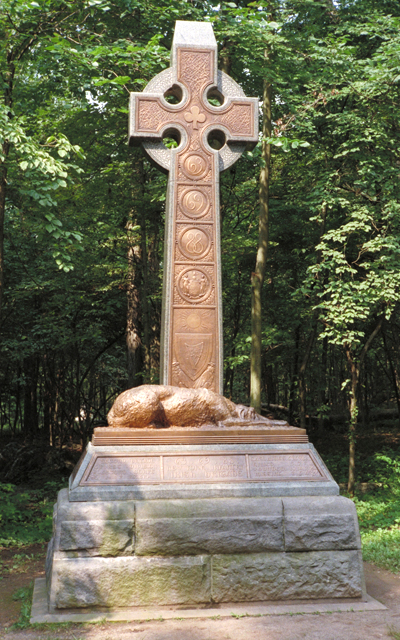
Monument to the Irish Brigade at Gettysburg
About the monument to the Irish Brigade
The monument is a Celtic cross supported by a granite base, standing 19’ 6” tall. It was sculpted by William R. O’Donovan, a former Confederate soldier who fought at Gettysburg. The front of the cross is an ornate bronze ornamented by a 2nd Corps trefoil, the numbers of the three New York regiments, the Seal of the State of New York, and a harp flanked by eagles. At the foot of the cross lies a life sized Irish wolfhound, symbol of honor and fidelity. The monument was dedicated on July 2nd, 1888.
Father William Corby, a chaplain to the Irish Brigade, attended the dedication, held a mass for the veterans and blessed the monument. “We have unveiled this pile, and it will stand to perpetuate the fame of those heroes. To keep their memory green in the American heart, this Celtic Cross has been erected. It is an emblem of Ireland, typical of faith and devotion, and the most appropriate that could be raised to hand down to posterity the bravery of our race in the great cause of American liberty.”
About the Irish Brigade at Gettysburg
The Irish Brigade was one of the legendary units of the Civil War. Three of its regiments were from New York. The other two were the 28th Massachusetts and the 116th Pennsylvania. With its numbers horribly thinned at Antietam and Fredericksburg, the three New York regiments could barely muster two weak companies each. But the Irish Brigade was still a force to be reckoned with when they were thrown in to support Sickles’ collapsing line on the afternoon of July 2.
One of the memorable moments of the battle came as the men of the Irish Brigade knelt while the Brigade Chaplain, Father William Corby, stood atop a boulder and pronounced general absolution to the men.
They then attacked into the Wheatfield, charging across into the Rose Woods and the Stony Hill. The Confederate advance was temporarily halted just a it threatened to overwhelm the entire Union position, although the brigade was flanked by Confederate Reinforcements advancing from the Peach Orchard and forced to withdraw back across the bloody Wheatfield.
 |
 |
Text from the front of the monument
Second Brigade First Division Second Corps
July 2, 1863, 6 p.m.
63 . 69 . 88 New York Infantry
Irish Brigade
Casualties 63 . 69 . 88
Killed 5 . 5 . 7
Wounded 10 . 14 . 17
Missing 8 . 6 . 4
Text from the rear of the monument
The brigade entered the battle under command of Colonel Patrick Kelly 530 strong, of which this contingent, composing three battalions of two companies each, numbered 240 men. The original strength of these battalions was 3,000 men. The brigade participated with great credit to itself and the race it represented, in every battle of the Army of the Potomac in which the Second Corps was engaged, from Fair Oaks, Jule 1, 1862, to appomattox Court House, April 9, 1865.

The sides of the base honor the 14th New York Independent Battery, who mustered in with the Irish Brigade but fought at Gettysburg attached to New York’s Battery B
Text from the side of the monument
14th New York Indept. Battery
In memory of Capt. James McK Rorty and four men who fell at the Bloody Angle July 3, 1863. The battery was mustered in December 9, 1861 as part of the Irish Brigade. It was detached therefrom and at Gettysburg was consolidated with Battery B, 1st N. Y. Artillery.

Right base of the Irish Brigade monument honoring the 14th New York Independent Battery

The wolfhound inscription
Text from the inscription just below the front paws of the wolfhound:
This, in the matter of size and structure, truthfully represents the Irish wolf-hound, a dog which has been extinct for more than a hundred years. – William Rudolph O’Donovan

Maker’s mark
Text from the maker’s mark inscription below the rear paws of the wolfhound:
John H. Duncan Architect
William Rudolf William Rudolf Sculptor
Maurice J. Power Founder
The New York regiments of the Irish Brigade honored on the monument are:
63rd New York Infantry
Lieutenant Colonel Richard Charles Bentley commanded the 63rd until he was wounded on July 2nd. Captain Thomas Touhy then took command. (see Captain Touhy’s Official Report on the Battle of Gettysburg.) The 63rd brought 112 men to the field in two companies (A and B) and lost 5 killed, 10 wounded and 8 missing. See more on the history of the 63rd New York in the Civil War.
69th New York Infantry
Captain Richard Moroney commanded the 69th until he was wounded on July 2. Lieutenant James J. Smith then took command. (See Captain Smith’s Official Report on the Battle of Gettysburg.) The 69th brought 75 men to the field in two companies (A and B) and lost 5 killed, 14 wounded and 6 missing. See more on the history of the 69th New York in the Civil War.
88th New York Infantry
Captain Denis Francis Burke commanded the 88th. (See Captain Burke’s Official Report on the Battle of Gettysburg.) It brought 126 men to the field in two companies (A and B) and lost 7 killed, 17 wounded and 4 missing. See more on the history of the 88th New York in the Civil War.

See more images of the Irish Brigade monument at Gettysburg
Location of the Irish Brigade monument at Gettysburg
The monument to the Irish Brigade is south of Gettysburg on the south side of Sickles Avenue just before the beginning of The Loop in the Rose Woods. (39°47’49.4″N 77°14’42.3″W)